08 July, 2011
The Museum of Atomic Surrealism
The first panels for "The Museum of Atomic Surrealism" (frags are a separate but related project :)
Goin' to Kansas City....Fringe Fest.
1. Atomic Fallout Shelter
2. Frags
3. Early Surrealism and Environmental Saints
4. Uranium Jewelry
06 July, 2011
Pink Fallout

http://www.youtube.com/watch?v=ynVctvyjSdQ
A video tribute and memorial to the Shoshone homelands preserved by the Ruby Valley Treaty signed in August of 1863. The Nevada Test Site violently destroyed treaty-protected Shoshone lands, but the Pink Cloud of the underground Sedan Nuclear Test 100 years later--on July 6, 1962--rained fallout down on the gardens of the Shoshone who lived in Duckwater, Nevada...
05 July, 2011
Cornelia Hesse-Honegger and Amy Franceschini: Conflict and Action
Cornelia Hesse-Honegger and Amy Franceschini:
Amy Franceschini is the kind of artist who is so complex, so multi-layered/multi-media/interdisciplinary, so focused on community and collaboration and empowerment that she is almost difficult to behold. Born in 1970 in Patterson, California, she is listed as part of the Net art and Eco art movements (Wikipedia).
This may be the first comparison between the two women that is relevant: they both know how to collaborate well with researchers. Franceschini collaborates with other artists and intellectuals, and Hesse-Honegger with the scientists and curators at the Natural History Museum where she worked as an illustrator. More recently, she has collaborated with designers to fund her travel and research.
Action in the face of the conflict between human beings and the environment
My priority for a comparative analysis of the work of contemporary artists in digital media was to find a relationship between two women artists, highlight green/sustainable/DIY culture, and, if possible, to relate it to my own work as an activist artist looking at the response of other artists through time to atomic technologies.
Amy Franceschini is the kind of artist who is so complex, so multi-layered/multi-media/interdisciplinary, so focused on community and collaboration and empowerment that she is almost difficult to behold. Born in 1970 in Patterson, California, she is listed as part of the Net art and Eco art movements (Wikipedia). In 1995, she founded Futurefarmers, an artists’ collective. In 2004, she founded Free Soil, a collective of artists, researchers, activists, and gardeners (Lippard, 2007).
If what Aaron Koblin said in his TED Talk (2011) is true; “…A wise media theorist once tweeted that …The culture of the 21st century will be defined by the interface,” well, Amy Franceschini had a jump start on that idea.
Cornelia Hesse-Honegger, in contrast, is now an elder artist, born in 1944 in Zurich, Switzerland. Her website states that, “For 24 years she worked as a scientific illustrator for the scientific department of the Natural History Museum at the University of Zurich. Since 1969 she has collected and painted leaf bugs, Heteroptera.” (Wissenskunst)
This may be the first comparison between the two women that is relevant: they both know how to collaborate well with researchers. Franceschini collaborates with other artists and intellectuals, and Hesse-Honegger with the scientists and curators at the Natural History Museum where she worked as an illustrator. More recently, she has collaborated with designers to fund her travel and research. In 1987 she took her first trip to Chernobyl and began to research and document the creatures most at risk for the genetic mutations near sites of nuclear radiation, including normally functioning nuclear power plants, sites of nuclear accidents, and sites where nuclear bombs were tested. Her findings contribute significantly to our ability to visualize these subtle mutations in heretoptera.
Her work is not predominately digital; however, the dissemination of it is resoundingly so. She works with traditional drawing and painting media, but she publishes via the internet on a website that is refined and elegant in its simplicity and directness.
Both women are working under the umbrella of ideas about environmental justice. Francheschini’s collaborations use digital media to document and disseminate work. Because she is so prolific, what emerges relevant to this comparison are three of her works;
The Unfinished Journey of Carl Linnaeus with Micheal Swain , 2007—an installation made for an exhibition curated by Lucy Lippard in Boulder, Colorado titled Weather Report: Art and Climate Change (Lippard 2007).
Victory Gardens 2007+ a history of Victory Gardens and a ‘subsidized garden initiative’ in San Francisco pointing out that “The World War II Home front was the most important and broadly participatory green experiment in U.S. History” (Franceschini 2008).
And third, I feel that I’d be remiss without mentioning her most recent work since it received the first ever Artists/Writers/Environments grant from the Nevada Museum of Art (NMA) Center for Art+Environment, This is Not a Trojan Horse “…concern[ing] rural regeneration in the Abruzzo region of Italy, where globalization has had a significant impact on traditional modes of farming and agriculture.” (A+E Conference schedule, 2011).
Hesse-Honegger’s completed studies are broken into four major geographies: Chernobyl, Nuclear power plants in Switzerland, Radiation-contaminated areas in Europe, and Contaminated areas U.S. (Hesse-Honegger Completed Studies). For the purposes of this comparison, I focused on the documentation related to Chernobyl, Switzerland and the U.S., which encompass accidents, ‘normally’ functioning nuclear power plants and, in the American landscape, both of those categories as well as the testing and manufacturing sites for atomic weapons production at Hanford and at the Trinity Test Site.
Some of the contrasts between these two women have been alluded to: they are from two very different generations, Franceschini is very comfortable as a ‘digital native’ who uses the web, digital graphic design, flash animation, and digital documentation inside a very fluid style of collaboration with others—to generate her considerable output.
Hesse-Honegger is a traditional illustrator whose ‘digital immigration’ has brought a much larger audience to her work. Her complexity is not limited just to a substantial body of drawings and her bibliography, however, as she does discuss funding her work by printing her illustrations on silk fabric used by major couture designers:
"1986 begins the work with the silk manufacturer ' fabric Frontline' Zürich, for whom I created 80 designs which were very successful and with which I could pay all my research. With the help of the silk I tried to create a positive utopia in contrary to the devastating findings among leaf bugs and around the nuclear power plants. My designs were use by Yves Saint Laurent, Balmain, Jil Sander as well as Vivienne Westwood. " (American Pest Control)
Both women are Utopians in some sense as Franceschini, in ‘Linneaus’ puts people in a replica of part of a research vessel in Boulder Colorado and told a fairy tale they are asked to finish: “The fairy tale is that three people escape to a remote location to solve the world’s problems. They drop out of the current carbon-dependent system to write their life’s work and a ‘plan’ to save humanity…” including “both sustainable systems and open source policy” (Lippard 2007). But there is a progression as a mature artists towards utopia even as there is a critical balance. Reading the carefully wrought graphic design for the Victory Garden 2007+, she has written “Victory = less CO2 emissions, neighborhood organizing, seed saving + independence from corporate food systems”…a utopian description for some of us, for sure! (Franceschini 2008).
Both artists are facile collaborators with specialists and researchers from other disciplines. Both focus their work with an eye towards Genius Loci, literally ‘Spirit of Place’. Both are international in that their work spans continents, addresses globalization, and requires funding for travel. Both are concerned with the interaction of human beings and the environment—and while Franceschini’s bio states that “An overarching theme in her work is a perceived conflict between humans and nature” (Futurefarmers), Hesse-Honegger’s biography says that “Her work is an interface between art and science; it plays witness to a beautiful but endangered nature.” (Wissenskunst).
Both women teach as well: Franceschini holds an MFA from Stanford and is currently a visiting artist at California College of the Arts and Stanford University. Hesse-Honegger’s extensive teaching was documented in a short article written for the American Pest Control website:
"Teaching at different Institutes as 'The peoples University' Zürich 1970 – 1992. 1976 –1991 Art teacher in a School for Gymnastics teachers, in Zürich. 1992 – 1995 teacher at the Gutenberg University of Mainz, Germany. I was named to create a postgraduate study in scientific illustration for biologists and artists. Teaching at the Art School in Vienna, Hamburg and Hanes Art School University Chapel Hill USA. 2000 – 2001 University in Bern Switzerland and since 2001 teacher at the virtual media art school F+F in Zürich. Private courses in Art and Collage." (08.03.2010)
So while both artists are interdisciplinary, concerned with environmental justice, and are teachers and researchers, the comparison is strongest when the idea that they are also activists comes into play. Franceschini recruited “artists, researchers, activists, and gardeners” when she co-founded Free Soil in 2004 (Lippard 2007). Something about working with a collective of artists prior to that (Futurefarmers) was suddenly opened up to a broader spectrum of specialists. The Victory Gardens 2007+ project would not have been as rich had there not been the extent of collaboration evidenced in the considerable research and development done to model and re-invigorate the third greening of San Francisco’s open space (there were the original WW-era Victory Gardens, a wave of a second era in the 1970’s Community Gardening movement, and her project in 2007+). In her book she depicts a rich history of Victory Gardens in the U.S. during WWII, but she also makes the tools and materials that generate new Victory Gardens in open spaces that would not otherwise have been producing food in San Francisco: so its not just about art or objects, but about activism.
Hesse-Honegger also knows her subject matter intimately and has become an activist in her own right. She literally illustrated leaf-cutter bugs at the National History Museum in Zurich for years before the accident in Chernobyl in 1986 caused her to visit there in 1987 to collect them herself around the sites where nuclear radiation has been leaked or where atomic weapons have been used or manufactured to illustrate the deformities in these creatures. She has wants us to see the potential for our own destruction in the genetic altering of these vulnerable leaf-eating bugs. She has become an activist in the face of a disturbing set of findings that only an artist could visualize with such clarity. Part of her activism came in the face of a resounding critique after publishing her first drawings: “Swiss scientists…expressed criticism of her research, insisting that the fallout in Western Europe from the Chernobyl accident was too small to cause morphological disturbances in insects.” (Wissenskunst). Rather than give up, she went to Swiss nuclear power plants to see if radiation leaks in those places would find the insects there also deformed.
Without digital technologies, the scale of access to these artists would be reduced to very 19th century ways of knowing: we might have access to their books and perhaps to a gallery exhibiting their work, but we would not be able to have access their work in our own homes or studios. We might see an article in print regarding their activism, but their research would not be models for new ways of seeing the interactions between human beings and their environments—at least not with the global immediacy they hold online. But more than that, without digital printing technologies, Hesse-Honegger’s silk fabrics and Franceschini’s books and artifacts would at least be much more difficult (and more expensive) to manufacture.
It is, however, important to point out that digital technologies are part of Franceschini’s process and not just the access points into her work. This is a significant difference between the two artists, and in the most recent video interview available with Franceschini from the Headlands Institute on March 3rd of this year, she talks about the contexts in which she works and they are about Sense of Place (and not the tools/technologies she’s using to bridge these places) stretching from an abandoned building in Philadelphia to a major museum in New York City, and on the campus at UCBerkeley. She does says “I’m a member of a collective…” which presumably means that she is collaborating to do these projects, although she is still very much at the center of the work she does.
There is something very significant about the level of collaboration and collective production that these women herald for this century: I would add to the idea that the 21st Century will be noted for our ability to interface with collaboration and specifically collective action. We no longer need the ‘auteur’ to guide factory-like production. We need smart people who see the interrelationships of their own strengths to best practices that can then guide us towards a future that is not only sustainable but that is organic, pristine, renewable, healthy, and without technologies that threaten our very survival.
American Pest Control Artist of interest: Spotlight on artist Cornelia Hesse-Honegger
< http://ampest.typepad.com/american-pest-control/2010/08/
artist-of-interest-spotlight-on-artist-cornelia-hessehonegger.html> . Web. 04 July 2011
“Amy Franceschini at the Headlands Center for the Arts” video by Daniel Tucker <http://www.youtube.com/watch?v=eWGc6GBxCyU>.Web.05 July 2011
"Amy Franceschini." Wikipedia, the Free Encyclopedia.
<http://en.wikipedia.org/wiki/Amy_Franceschini>.
Web. 04 July 2011
Center for Art+Environment Conference Schedule, 2011. Nevada Museum of Art. <http://www.nevadaart.org/conference2011/schedule.html>.
Web.04 July 2011
Futurefarmers Amy Franceschini. <http://futurefarmers.com/about/> .Web.04 July 2011
Hesse-Honegger, Cornelia, Cornelia Hesse-Honegger: Art on Silk, 1986
Hesse-Honegger, Cornelia; Heretopia, 1982
Aaron Koblin: Artfully visualizing our humanity. TED Talks, February 2011, Long Beach, California <http://www.ted.com/talks/lang/eng/aaron_koblin.html> Web. 04 July 2011
Lippard, Lucy, Weather Report: Art & Climate Change. Boulder Museum of Contemporary Art,
Boulder, Colorado, 2007
Lippard, Lucy, introduction for Victory Gardens 2007+ Gallery 16 Editions, San Francisco, 2008
Wissenskunst, Corneilia Hesse-Honegger.
Biography. <http://www.wissenskunst.ch/en/biographie.htm> .Web.04 July 2011
Completed Studies. <http://www.wissenskunst.ch/en/usa_6.htm>.Web.04 July 2011
<http://www.wissenskunst.ch/en/biographie_2.htm>. Web.05 July 2011
29 June, 2011
Atomic Story Sharing
This is a webpage design for a crowd- sourcing call for sharing artifacts and stories related to nuclear and atomic technologies.
Testimonials may be the only truth we ever have access to...
...and almost everyone in Nevada has a
story to share...
Testimonials may be the only truth we ever have access to...
...and almost everyone in Nevada has a
story to share...
28 June, 2011
27 June, 2011
The Yes Men and Chris Jordan
FOR IMMEDIATE RELEASE:
YES MEN FIX THE WORLD WHILE RUNNING THE NUMBERS WITH CHRIS JORDAN:
Or, Where is the line between art and activism and what does that mean in the future?
In a Yes Men Fix The World curriculum guide downloadable on their website, an interesting paradox presented on the title page becomes s a statement that creates a framework for a comparison of the activist artists Andy Bichlbaum (Jacques Servin) and Mike Bonanno (Igor Vamos) with Seattle-based photographer Chris Jordan:
“Sometimes it takes a lie to expose the truth”.[1]
The Yes Men use activist interventions, performance art, video animation, and writing to confront corporations and market forces they see as having the potential to “…happily drive the whole planet off a cliff”. Chris Jordan’s photographs ask us to think about our individual responsibility in graphic terms as he makes the sheer magnitude of consumption, incarceration, military spending, etc. comprehensible to his audiences. Jordan says in a recent TED video clip that he is worried about us: “The reason that I do this, its because I have this fear that we aren’t feeling enough as a culture right now, there’s this kind of anesthesia in America at the moment. We’ve lost our sense of outrage, our anger, and our grief about what’s going on in our culture right now,, what’s going on in our country, the atrocities that are being committed in our name around the world—they’ve gone missing.”[2]
Jordan takes a lie and makes it truthful by using a series of computer scans or digital images and reproducing them to catalogue the unprecedented and mind-boggling data we’re confronted with, making the numbers of cups discarded in a single six hour period of time on airlines in America comprehensible in one gigantic photographic canvas where he uses design and references the history of art to make this data real to us. It is a lie that exposes the truth, essentially, because there is no real way to assemble that many plastic cups in a single photograph without computer-assisted technology and still have the details of the photographs be intelligible. But Jordan—who was a corporate lawyer for ten years prior to working as a full-time artist[3]-- keeps a meticulous command of the statistics and data that propel his imagery so that we are convinced of his truthfulness even as we try to see in his images where the plastic bottles repeat themselves or as we look at the succession of toothpicks trying to find where they are seamed together in the prairie they cover so completely.
The Yes Men are much more flamboyant about their lies, but have discovered and exposed essentially the exact same lack of feeling described by Jordan in their audiences. One story in “The Yes Men Fix The World” traces their invitation to represent the WTO based on their online “corrected” website found at http://www.gatt.org/. They arrived to give a presentation as representatives of the WTO, and then, ripping off Mike’s newly-purchased thrift-store suit, exposed a gold lame super-hero-style spandex suit with an inflatable phallus with a “hands free” television set that would allow corporate executives “real-tine” supervision of their international operations and instantaneous supervision of all workers in their employ. Here too the Jordan quote about feelings fits perfectly, except that this cultural “anesthesia” is not just American, but may instead be middle class and part of a multi-national corporate culture as the reaction of the Yes Men’s western European audience to their presentation was so polite they wee asked to attend a dinner where Servin was seated at the head table as an honored guest.
Jordan doesn’t want you to leave his work without thinking about what you can do as an individual to change the world, however, and in the same TED video, he says he wants his work to be seen as a catalyst for a very personal change: " How do we change? How do we change as a culture, how do we each individually take responsibility for the one piece of the solution that we are in charge of—and that is our own behavior."[4]
I think the Yes Men would agree, except that their vision is less passive. They operate a “Yes Men Lab” where NGO’s and institutions of higher education can contract with the Yes Men to address tangible corporate encroachment into their own communities. On their website now is the results from just such a collaboration:
"Students from Columbia College in Chicago came together with Greenpeace and The Yes Lab to take on theChicago coal industry. The group created an elaborate scheme to announce that a new Coal Plant was planned – but instead of going in a poor neighborhood (like the two coal plants that already exist), this one would be built in a rich one."[5]
These kinds of collaborations, the Teacher’s Guide to the Yes Men film, and their respective careers as professors tell me that Servin and Vamos are very much rooted in being teachers. They have figured out how to illustrate truth to power, as well as how to manipulate the media with such grace that that actually becomes the vehicle for spreading their message. Perhaps most important, though, is their ability to move people to action. The teachers guide actually says, “Hope explodes at the end of this film with a power that may take students out of the classroom and into the streets.”[6]
Jordan is similarly moved by students who react to his work. Although his contemplative style may be seen as encouraging a more deliberative and disciplined internalization of social change by individual viewers, his blog includes a 4-minute video on his work documenting the baby albatross’ killed by ingesting plastic and then dying where Jordan then photographed the carcasses and the pollution exposed inside them on Midway Atoll. Grade school students looked at Jordan’s photos, and then collected bottle caps (part of the very recognizable trash that kills the birds) and made a mosaic mural of a healthy albatross in flight with the caps they had brought from home. These students internalized the message in a very heartfelt way, and Jordan says in the video, “One of the leaps that’s hard to make in this work is from the despair and the kind of horror of the phenomenon out there to hope, empowerment and action…and, to see…[he falters, emotional], “and to see these kids achieving that is really powerful.”[7]
The complexity of all three of these artists’ works and their relationship to a sense of responsibility to community and to environmental and social justice move us to think, to consider, and to act. While the Yes Men’s work allows for a sense of humor and a volatility that comes from juxtaposing corporate culture with the absurd in the public spectacle, Jordan’s visualizations of data are somehow more contemplative (although one might argue that reading a publication detailing the latest Yes Men lab results might require a more contemplative mindset from a reader/viewer while at the same time arguing that Jordan’s photographs are a kind of silent public spectacle…). Both bodies of work ask us to internalize the idea that change is possible if we choose to take action to make it so.
When I walked out of the Jordan show, I threw away a paper coffee cup and a sandwich bag.
I thought about it, and in thinking about my thinking I found myself wanting to change that habit…
24 June, 2011
Summer Solstice
http://www.unr.edu/art/site/areas_of_emphasis/digital_media/projects/laurafillmore.html
This is a collection of 30 second videos shot on the first day of summer...
It was the longest day of the year, and I went to school (twice), visited with the 'boys' in the morning, watched Gracie jump around on the trampoline, and between classes visited with T'o'o' Herman, getting him out in the sunshine for a little bit...please excuse the singing, it's how we always visit when we're alone together.
This is a collection of 30 second videos shot on the first day of summer...
It was the longest day of the year, and I went to school (twice), visited with the 'boys' in the morning, watched Gracie jump around on the trampoline, and between classes visited with T'o'o' Herman, getting him out in the sunshine for a little bit...please excuse the singing, it's how we always visit when we're alone together.
20 June, 2011
All Fallout is Local
An animated short by a neophyte photoshopper...
http://www.youtube.com/watch?v=63nEnowWSFU
M.O.A.B. (Mother of All Bombs/Mother Uranium)
in an introductory conversation with her sister,
the Goddess of Blowback,
Nemesis...
http://www.youtube.com/watch?v=63nEnowWSFU
M.O.A.B. (Mother of All Bombs/Mother Uranium)in an introductory conversation with her sister,
the Goddess of Blowback,
Nemesis...
Re-Jette with a Burden
http://www.youtube.com/watch?v=-e76JdnC6Kc
This is five minutes of footage set to the opening of Chris Marker's La Jette soundtrack and 15 seconds of news footage of a major fire in Reno, Nevada set to a short audio file from Chris Burden titled "Atomic Alphabet".
La Jette: (I sampled beginning at 2:12 here)
http://www.youtube.com/watch?v=mzPi7-faGkw
Atomic Alphabet:
http://www.ubu.com/sound/burden.html
This is five minutes of footage set to the opening of Chris Marker's La Jette soundtrack and 15 seconds of news footage of a major fire in Reno, Nevada set to a short audio file from Chris Burden titled "Atomic Alphabet".
La Jette: (I sampled beginning at 2:12 here)
http://www.youtube.com/watch?v=mzPi7-faGkw
Atomic Alphabet:
http://www.ubu.com/sound/burden.html
13 June, 2011
11 June, 2011
Andre Breton and the Dawn of the Atomic Age
Dadadadadadadada
Liberation. anti-art
anti-bourgeois
anti-nationalist
anti-dote and then
surrealism. automatism
thinking juxtaposed
born of the montage
of cinematic editing
of the dream state
encroachment
of Freudian
psychology
thinking
no longer
spitting
but
super
real
so
…
where in the West did the cosmopolis intersect with the burden of marriage gone listless?
& where did the Surrealists’ reclaim the same institution?
Or
The Architect of Surrealism gets a Divorce in Nevada at the Dawn of the
Atomic Age
“Dada means nothing. We want to change the world with nothing.” --Richard Huelsenbeck
Dada, born from the rebellion against the nationalism and flag-waving that gave rise to World War I, began as a performance and exhibition at the Café Voltaire in Zurich Switzerland in 1916. Dada rocketed—in eight short years—to an international movement among women and men of arts and letters that asked the question, “What is dada?” and answered itself with another question, “Or is it nothing at all, in other words everything?” Dada’s ambivalence was never meant to be referred to as a movement, and yet it continues to have life for artists and art-lovers and somehow its youthful transition to Surrealism left it forever fresh in our minds.
Hannah Hoch, photomontage
From Andre Breton’s 1924 Surrealist Manifesto:
SURREALISM, noun, masc., Pure psychic automatism by which it is intended to express, either verbally or in writing, the true function of thought. Thought dictated in the absence of all control exerted by reason, and outside all aesthetic or moral preoccupations.
By 1941 Andre and Jacqueline Breton must have been so weary of war, weary of rations, weary of hearing of the crushing of their Jewish friends and the French Resistance as they met with the Emergency Rescue Committee to plan their exodus to New York City to wait out WWII.
The Emergency Rescue Committee office in Marseilles
L to R: Max Ernst, Jacqueline Lamba, Andre Masson,
Andre Breton and Varian Fry
Perhaps Andre day-dreamed of his mentor Jacque Vache, a poet soldier whose Lettres de guerre from WWI had introduced the spirit of rebellion that marked every enterprise Breton had initiated since. By 1941 some twenty-five years of rebellion was the foundation of a mature reputation for Breton, the author of poetry, collector of artworks, a fierce intellectual fueled by the spirited thinkers and artists he courted. For Breton, resistance had become habitual.
During the long wait for the wars to subside, and now for safe passage to America to be secured, Andre and Jacqueline and their close friend Yves Tanguy played at making Equisite Corpse, a favored collaborative game of the Surrealists. But by 1940 Yves had left for America, and in ‘41 Andre had been arrested and held briefly by the Vichy government of France, where their official report on him described him as a “…dangerous anarchist sought for a long time by the French police.”
Andre Breton, Jacqueline Lamba, Yves Tanguy
Cadavre exquis ‘Exquisite Corpse’ 9 February 1938
Breton would travel here with his little daughter Aube and his second wife—her mother—the beautiful Jacqueline Lamba, joining the other Surrealists already in New York. Peggy Guggenheim paid their passage, having been asked by painter Kay Sage to sponsor their trip. Andre’s reputation with the Vichy government proceeded him, though, and he would be imprisoned in a concentration camp briefly in French Martinique when they arrived on the Capitaine Paul-LeMerle.
While in Martinique, he met with Aime Cesaire, encouraging him to “use surrealism as a weapon”. Their friendship would endure, and Breton would write the introduction for Cesaire’s “Notebook of a Return to the Native Land” in 1947. Breton was said to have finally arrived in the U.S. in June, 1941 “in no mood” for white society.
Perhaps the Breton’s reunion with Yves Tanguy and Kay Sage was quite lovely, certainly they were at the center of a group of artists and intellectuals that was extraordinary: Imagine attending gatherings with Willem de Kooning, Robert Motherwell, Mark Rothko, Max Ernst, Kurt Seligmann, Andre Masson, Arshile Gorky, David Hare, Fernand Leger, Piet Mondrian, Marc Chagall, Pavel Tchelitchew, Robert Matta and a young Jackson Pollock. Paul Eluard, Man Ray, and Marcel Duchamp would soon join them stateside.
Kay Sage’s brother, David Hare—who Motherwell remembered later as having had “an independent income” agreed—after a tumultuous turnover of others who had accepted the task—to be the nominal editor of VVV, the surrealist anthology that Breton and others collaborated on in Grenwich Village, publishing four issues from 1942 through February of 1944. The last cover was illustrated by the Chilean surrealist Matta:
But every artist has an exquisitely personal story too. Andre Breton had met Jacqueline Lamb in a café when she was a water-dancer at the Coliseum, a cabaret in Pigalle. She’d read his writing and long had wanted to meet him…she is said to have seduced him on the 28th of May, 1934, and he named it “The Night of the Sunflower,” after a poem he’d written prior to that.
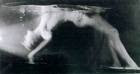
Jacqueline Lamba performing at the Coliseum
When they married on August 14th of that summer, Alberto Giacometti was the witness for the bride, Paul Eluard the witness for the poet, and Man Ray their photographer. Their daughter Aube Elléouët Breton was born on the 20th of December, 1935.
However sweet, their marriage didn’t survive their stay in New York. David Hare had published a large-format book of color photographs titled Pueblo Indians as They Are Today in 1941, and it may have been that book that introduced Breton to the tribes of the American Southwest—Hare must have been refreshing as Breton was increasingly interested in utopia and community as a resolution for the conflict of wars he had been surrounded by for 25 years.
Certainly David Hare had endeared himself to the Bretons, Jacqueline, it seemed, more so than Andre. Somewhere along the way there was a touch and a first kiss and the elder Breton knew enough about passion to look the other way. After all, it was in 1918—as he had begun to disagree with Tristan Tazara about the foundations of Dada—that he’d written this:
Leave your wife.
Leave your mistress.
Leave your hopes and fears.
Leave your children in the woods.
Leave the substance for the shadow.
Leave your easy life,
leave what you are given for the future.
Set off on the road.”
De Diego, David Hare, Jacqueline and Aube Breton, c. 1945
Photograph by Julien Levy
Andre Breton would find another companion, and his third and final marriage lasted until his death. According to Martica Sawin in Surrealism in Exile and the Beginning of the New York School, Breton met the Chilean Elisa Claro in January when “…in the midst of a snowstorm, he had stopped for lunch at a favorite refugee hangout, Chez Larre, and had noticed a woman with an overwhelming sadness on her face. He subsequently learned that her eleven-year-old daughter had drowned the previous summer while at a camp in Cape Cod and that she herself had attempted suicide.” Andre himself felt he’d lost his own daughter, and so they must have traded stories of heartbreak that day as they were drawn to one another.
Their path west to Reno together was paved for them by an obscure surrealist sculptor, Heinz Henghes. Henghes, who had first introduced Kay Sage to Yves Tanguy when she was still married to an Italian prince, eventually studied with Isumu Noguchi in New York. Later, he followed his estranged wife to Reno in 1932. He attempted suicide and spent time in an asylum in Reno before obtaining a divorce. Tanguy had later traveled to Reno with Sage and they were married here on August 17, 1940.
Andre Breton did not discover the French utopian Charles Fourier until 1940, and began to read his writings while still in New York. In the summer of 1945, the surrealist poet threw the utopian’s collected works in the back seat and set out on a cross-country trip to Reno, where he would divorce, remarry, and begin the poem Ode a Charles Fourier. Andre and Elisa traveled through Chicago on the way, and they’d later tell the Chicago surrealists that they had very much liked the city then.
Elisa Breton, 1942, New York
Marcel Duchamp wrote Breton and Elisa a letter on July 2, mailed to Breton inReno, about a window display he was creating for Breton’s publication Le Surrealisme et la Peinture. Breton was also said to be reading the Japanese Book of Tea during that time. He must have found the Japanese internment in camps alarming—he’d have seen the “racial profiing” of his day through the lens of his own recent internment in Martinique.
While in Reno, there are references to Breton collecting pebbles from the shores of Lake Tahoe with artist Jeanne Reynal, who was asked to look after him by Peggy Calder Hayes, sculptor Alexander Calder’s sister. And although he would later testify that he’d stayed in Reno “…every day since June 16th up to and including the present day,” he must have taken other day trips—one to Virginia City, for in “Ode to Charles Fourier” there is an unmistakable reference to that place:
Fourier I salute you from the Grand Canyon of
Colorado
I see the eagle soaring from your head…
I salute you from the Nevada of the gold-prospector
From the land promised and kept
To the land rich in higher promises which it
must yet keep
From the depths of the blue ore mine which
reflects the loveliest sky
For always beyond that bar sign which continues
to haunt the street of a ghost town—
Virginia City—“The Old Blood Bucket”…
Breton’s divorce lawyer was a force to be reckoned with in the state of Nevada: Felice Cohn. Historian Jean Ford wrote about her considerable achievements:
Jacqueline Lamba was represented in the Second Judicial District Court of the State of Nevada by Maurice Joseph Sullivan, a democrat who was once Lieutenant Governor of Nevada and who had just finished a term of office as U.S. Representative at large in January.
Breton stumbles through the divorce proceedings—saying, in the transcripts, “I come the 14th, the 16th of June,” Cohn immediately asks him then, “July?” Breton replies, “June.” “Of this year?” Cohn persists. “I’m sorry,” Breton says hurridly, “because I don’t speak English.” He testifies that he and his wife have been separated for three years. Elisa and Andre had been in Reno at the guest house of Fred C. Jacobitz, at 157 Mill Street (now the post office parking lot on the northwest corner of Mill and Center) during the obligatory six weeks of residency that qualified the divorce.
The divorce is granted on July 30, 1945. He marries Elisa the same day, and they begin their trip to the Pueblos and Mesas of southwest immediately. It is almost as if Breton was attracted to the site of a momentous shift as a firefly bekons a child at dusk...
On writing the Ode a Charles Fourier, Breton later suggested that the poem “…contains something of the very strange atmosphere…where slot machines…line the walls of food-shops and post-offices alike, gathering round them in a vague kind of way the crowd of those aspiring to a new conjugal life, the cow-boys and the last gold prospectors.” Obviously he understood the spirit of this place.
Exactly one month to the day after Andre Breton’s divorce waiting period had begun in Reno, so too began the birth of the Atomic Age. On July 16th, 1945, in the Jornada del Muerto desert, literally, ‘Working Day of Death,’ 35 miles southeast of Socorro, New Mexico, the Trinity Test of an implosion-design plutonium device birthed the atom bomb.
And Breton was not oblivious, writing in Ode:
Because the “Veil of Bronze” has survived the rent you tore in it
And covers even more completely scientific blindness
“No one has ever seen a molecule, or an atom, or an atomic
link and it’s unlikely anyone ever will” (Philosopher).
Prompt proof to the contrary: in swaggers the molecule of rubber.
A scientist though provided with black glasses loses his sight
for having observed at several miles distance the first
atomic bomb tests (The newspapers).
And then, on August 6th, 1945, an atomic bomb was exploded over Hiroshima, followed by another on August 9th over Nagasaki. The photographs of a devastated Hiroshima were printed in Life Magazine on August 20, 1945. There was a collective outcry from artists all over the world. Iris and Toshi Maruki, Keiji Nakazawa, Salvador Dali, Roberto Matta, Denis de Rougemont, Langston Hughes, Laslo Maholy-Nagy, Ben Shahn, Diego Rivera, Henry Moore, Isumu Noguchi, and Jacob Lawrence responded, as have many contemporary artists.
And as the work continues,
shall we fight something with nothing?
Illustration by Roberto Matta for Lettres sur la bombe atomique,
1946 Denis de Rougemont
“ART does not exist, no doubt—it is therefore useless to sing about it—
and yet we make art—because that’s the way it is—
Well-what are you going to do about it?”
--Jacques Vache 18-8-17
Subscribe to:
Posts (Atom)